

If the Volcanic Eruption Doesn’t Scare You, the Mudflow Should
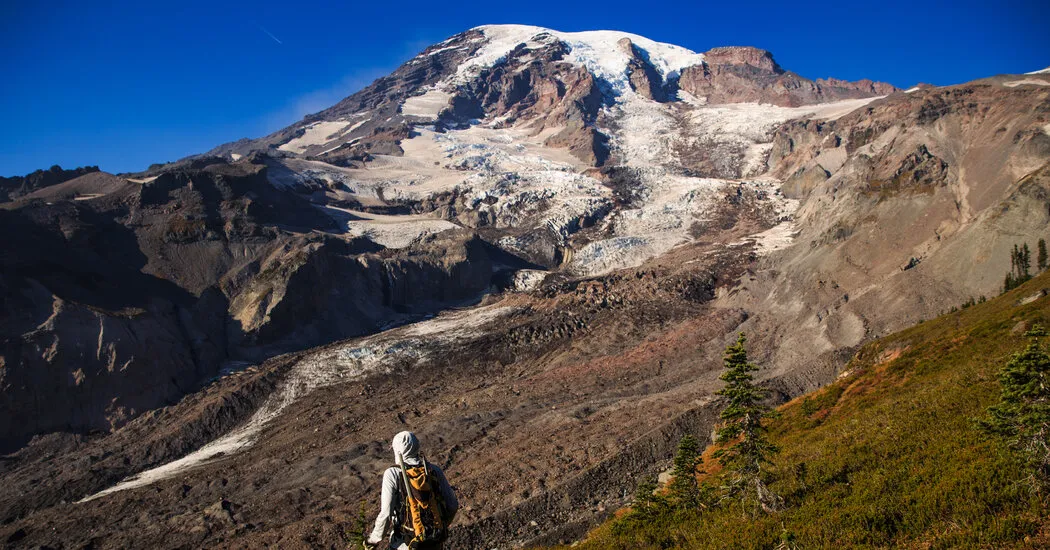
An outpouring of magma isn’t the biggest risk to people downhill from Mount Rainier in Washington. The active volcano’s greatest danger comes from lahars — amalgams of mud, rock and water that are as dense as wet concrete.
Over the past several thousand years at least nine large lahars have barreled down the steep slopes of the 14,410-foot mountain, sometimes reaching as far as the Puget Sound some 60 miles away. The largest lahar of the past 1,000 years was known as the Electron Mudflow, named for the small hamlet of Electron.
That event buried the nearby landscape in nearly 20 feet of mud. But scientists have struggled to precisely date when this event occurred. Knowing the year could make it possible to correlate the lahar with other events and therefore better predict future muddy outbursts.
In a study published last month in the journal Geology, a team of geoscientists believe they have worked out the year of that calamity by studying trees submerged by the lahar.
The Electron Mudflow, rich in slippery clay, sent debris coursing up to 35 miles away from the mountain, into what is now the small city of Orting. Previous research estimated the event occurred about 500 years ago, give or take a century or two.
Scientists believed they could use dendrochronology, or the study of tree rings, to determine a more precise date. That’s because a lahar tends to bury, uproot and otherwise kill trees, said Bryan Black, a tree ring scientist at the Laboratory of Tree-Ring Research at the University of Arizona. “Trees don’t survive long.” A tree’s outermost ring can therefore record the precise passage of a lahar to the nearest year or even season.
Thank you for your patience while we verify access. If you are in Reader mode please exit and log into your Times account, or subscribe for all of The Times.
Thank you for your patience while we verify access.
Already a subscriber? Log in.
Want all of The Times? Subscribe.