

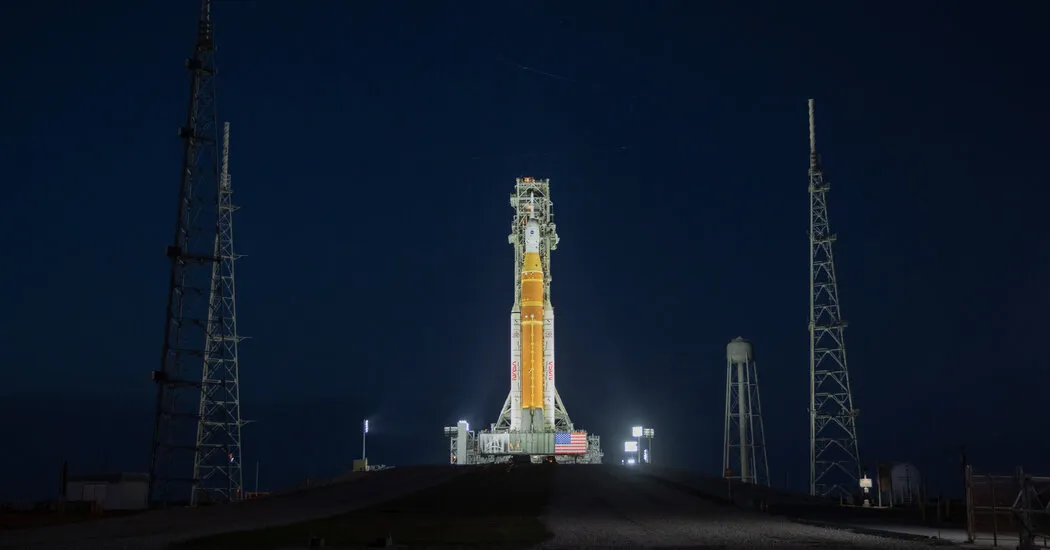
NASA Eyes March Artemis II Launch After Hydrogen Leaks Delay Moon Mission
NASA announced on Tuesday that it would not try to launch astronauts on an around-the-moon trip until at least March. The decision was made after the agency was unable to complete a countdown rehearsal that started on Saturday.
NASA officials had hoped that the Artemis II mission, which would be the first time humans leave low-Earth orbit since the end of the Apollo moon landings more than 50 years ago, might be able to launch as soon as next Sunday.
But that would have required a smooth run-through of what the space agency calls a wet dress rehearsal. This two-day test includes filling up the tanks of the giant Space Launch System rocket, a vehicle that includes leftover parts from the space shuttle program, with millions of pounds of liquid hydrogen and liquid oxygen propellants.
For the test run on Launchpad 39B at the Kennedy Space Center in Florida, no astronauts were aboard, and the engines would not ignite. The countdown clock was to tick down to about half a minute to check that the rocket and other systems were operating properly.
But during fueling, a leak of hydrogen occurred at the interface between the rocket and the launchpad. That was an echo of problems that delayed for months the launch of Artemis I, an uncrewed test flight that circled the moon in 2022. Hydrogen molecules, which consist of pairs of hydrogen atoms, are tiny and notoriously difficult to keep confined.
Running hours behind schedule on Monday, mission managers persevered — stopping the flow of hydrogen and allowing seals within the connection to warm up.
“We did that a couple times, worked our way through it,” Charlie Blackwell-Thompson, the launch director, said during a news conference on Tuesday.
The rocket’s propellant tanks were eventually filled. That allowed the countdown to proceed into the last 10 minutes. But the hydrogen leak reappeared when the propulsion system was pressurized, rising above the allowed 16 percent concentration, and the rehearsal was scrubbed shortly after midnight with about five minutes left in the countdown.
“With more than three years between SLS launches, we fully anticipated encountering challenges,” Jared Isaacman, the NASA administrator, said on social media early Tuesday morning. “That is precisely why we conduct a wet dress rehearsal. These tests are designed to surface issues before flight and set up launch day with the highest probability of success.”
In an update, NASA said other problems encountered during the countdown included a loose valve and dropouts in audio communications, the agency said.
Mission managers will review data, make fixes to the rocket and launch systems and run another dress rehearsal before setting a launch date.
”I don’t expect it will take us too long to get to that point, but we are still in the process of assessing the data that we collected yesterday and developing the plan,” said Lori Glaze, the acting associate administrator for NASA’s exploration systems development mission development directorate.
At present, mission managers believe the repairs can be performed at the launchpad.
The next available launch date is Friday, March 6, one of five possible in March.
Artemis II will send four astronauts — three from NASA, one from Canada — on a 10-day journey that will swing around the moon without landing. That will provide a crucial test of the life support systems on the Orion capsule before the following mission, Artemis III, is to land on the surface of the moon.
The astronauts, who had been in quarantine to avoid becoming sick before launch, are free to interact with other people for now.
“The crew just shared a peaceful breakfast with our families,” Reid Wiseman, the NASA astronaut who is the commander of Artemis II, said on social media, “and we jump back into training tomorrow to start our preps for a March launch to the moon.”
On X, Mr. Isaacman said that the S.L.S. rocket would continue to be used through Artemis V, but that the long gaps between flights meant that “it is not the most economic path and certainly not the forever path” for taking people to the moon.
President Trump’s call for establishing a lunar outpost requires “repeated and affordable missions to the lunar environment,” Mr. Isaacman said.
Commercial alternatives could include Starship from Elon Musk’s rocket company, SpaceX, and New Glenn from Jeff Bezos’ Blue Origin rocket company.
During the news conference, Amit Kshatriya, NASA’s associate administrator, agreed that S.L.S. would always remain an “experimental” rocket.
“These are very bespoke components,” Mr. Kshatriya said. “In many cases, made by incredible craftsmen.”
The delay of Artemis II would have cleared the way for a different NASA mission to send a new group of astronauts to the International Space Station on a SpaceX rocket.
That mission, known as Crew-12, was to launch as soon as Feb. 12. But SpaceX also encountered trouble on Monday, when the second stage of one of its Falcon 9 rockets did not perform a final engine burn to push back into the atmosphere for disposal.
The problem occurred after the rocket had successfully deployed 25 of SpaceX’s Starlink internet satellites. In a statement, SpaceX said it would investigate and make fixes before resuming Falcon 9 launches, which include the Crew-12 mission.
If that analysis occurs quickly, Crew-12 could still launch as planned.
Russia’s ability to launch astronauts to orbit is also grounded for the moment after a service platform at the launch site was badly damaged in November. In December, Roscosmos, the state corporation that oversees Russia’s space program, said the launchpad would be repaired by the end of February.